Life is what happens.

Change.

This is a word that has defined my life ever since the dairy man came into it.

Almost nothing that college-aged Jess expected out of life came true. I didn’t move to a big city, I didn’t become a journalist, and I don’t own a single pair of Manolos. I drive a well-loved car that is almost always muddy/manure-y and have an old farmhouse instead of a ultra-mod loft apartment.

But, much to old Jess’ surprise, change is not a bad thing.

The quote that best sums up my life thus far is from John Lennon: “Life is what happens when you make other plans.” I’ve spent so much time making plans and life has happened in spite of them. God laughed at my plans. Somehow the things I was trying so hard to avoid ended up bringing more joy than I could have ever imagined. This life is different than I planned but, in a lot of ways, it’s better.

A recent change of note is the end of my life as a long-distance commuter. I started a new job this week for our county in an office a mere 15 MINUTES from home. After over a year of driving 80+ minutes to work (one way!), this is insanity.

It was crazy difficult to leave the people I worked with for the past three years, but I know this change was the right one. That being said, I’m having a heck of a time wrapping my mind around it. Work ends at 5 and I’m pulling into my driveway at 5:15. What do people do with all of this time? I have big plans for exercise, puppy playdates, and tackling my book list. But a small part of me still feels a twinge of panic.

Even though I moved to the country a little over a year ago, in a lot of ways, I didn’t move. I still had the same job in the same city (emphasis on CITY); I saw the same people; I could eat at the same restaurants. I had to drive a lot further to get to these things, but they were still available to me on a daily basis. In many ways, I was the same old urbanite. I still don’t know my way around our small town because I’m never here.

Now I’m moving. For real. My whole life—home, job, and friends—will be up here. I know the city isn’t that far away (as evidenced by the fact that I used to drive back and forth to it every. single. day), but it’s not going to be as easy to get there. I’m starting a new chapter: “City girl really really moves to the cornfields.” My job change will have a ripple effect into every part of life.

But change is a part of life.

Because let’s be honest here; the Jess of my college years would have laughed hysterically at the prospect of living in the country, tromping through cow poop, and being married to a farmer. But here I am. This is my (happy) life. Somehow all of these changes make my heart swell with contentedness. I have found bliss in the most unexpected place.

And now I have more time to be here. A frightening blessing. I still will not learn how to milk (because, as a wise farm wife once told me, “If you know how to milk, you might have to!”), but I’m looking forward to joining the gym, cooking meals that take longer than 30 minutes, and writing more. While I’m sad to leave my half city life and my wonderful coworkers (one fabulously snarky boss in particular), I’m excited to start this new job. I’m excited to build new relationships. And I’m excited to take a leap that more fully invests me in this life up north with my dairy man.

Bring on the changes.

Aw, Shucks. Wrapping up a Corn(y) Harvest

Please forgive the title. It’s early and I’m a few cups (ok, a few thermoses) of coffee away from a sharp sense of humor. For now, it makes me giggle.

Anyway. Corn.

In farming, there are essentially two periods of complete insanity each year. Sure, there are little sprinkles of craziness between the two, but planting and harvesting (in my mind, at least) are the busiest times of year on the farm.

We (again, I’m using this pronoun loosely) plant corn every spring. The process typically takes a few weeks and the days are long, long, long. The Dairy Man will spend hours upon hours in a tractor. I see him for brief meals on the go, or I don’t see him until he’s crawling into bed. So, that’s spring. After a summer of basking in the sun and growing tall and leafy, our corn stalks are ready to be harvested in early fall.

Two weeks ago we wrapped up the corn harvest. Excuse me for a moment while I pop a bottle of champagne and do a slightly awkward happy dance.

Finishing corn harvest is a significant milestone. At this point, things really slow down for farmers (with the exception of one more hay cutting). I’ve always loathed the cold and snow of winter, but I do enjoy the moderate reprieve in the farming lifestyle that comes during the colder months. Things move a little more slowly. The days are shorter and a “dawn till dusk” workday is inevitably truncated. I eat carbs, wear thick sweaters, and actually get to spend evenings with my husband.

As we entered our second harvest as a married couple, I started to get flashbacks of this time last year. These flashbacks, naturally melodramatic and a little bit whiny, reminded me of a time when I barely saw my husband, ate my meals alone, and did all of the housework by myself. These were the dark days of a newlywed country transplant. It’s a good thing the Dairy Man had the sense to marry me before corn harvest. I was already locked in. But I digress. This year I had the benefit of a toughened psyche thanks to 12 months of farming fun. When the Dairy Man said, “Well Jess, we start corn harvest tomorrow,” I knew what to expect.

With my commute and work schedule, I wasn’t able to get as many in-action harvest shots as I would have liked, but I did get a picture of THE PACK. Well, more specifically, it’s one of THE PACKS, but this is the biggest by far.
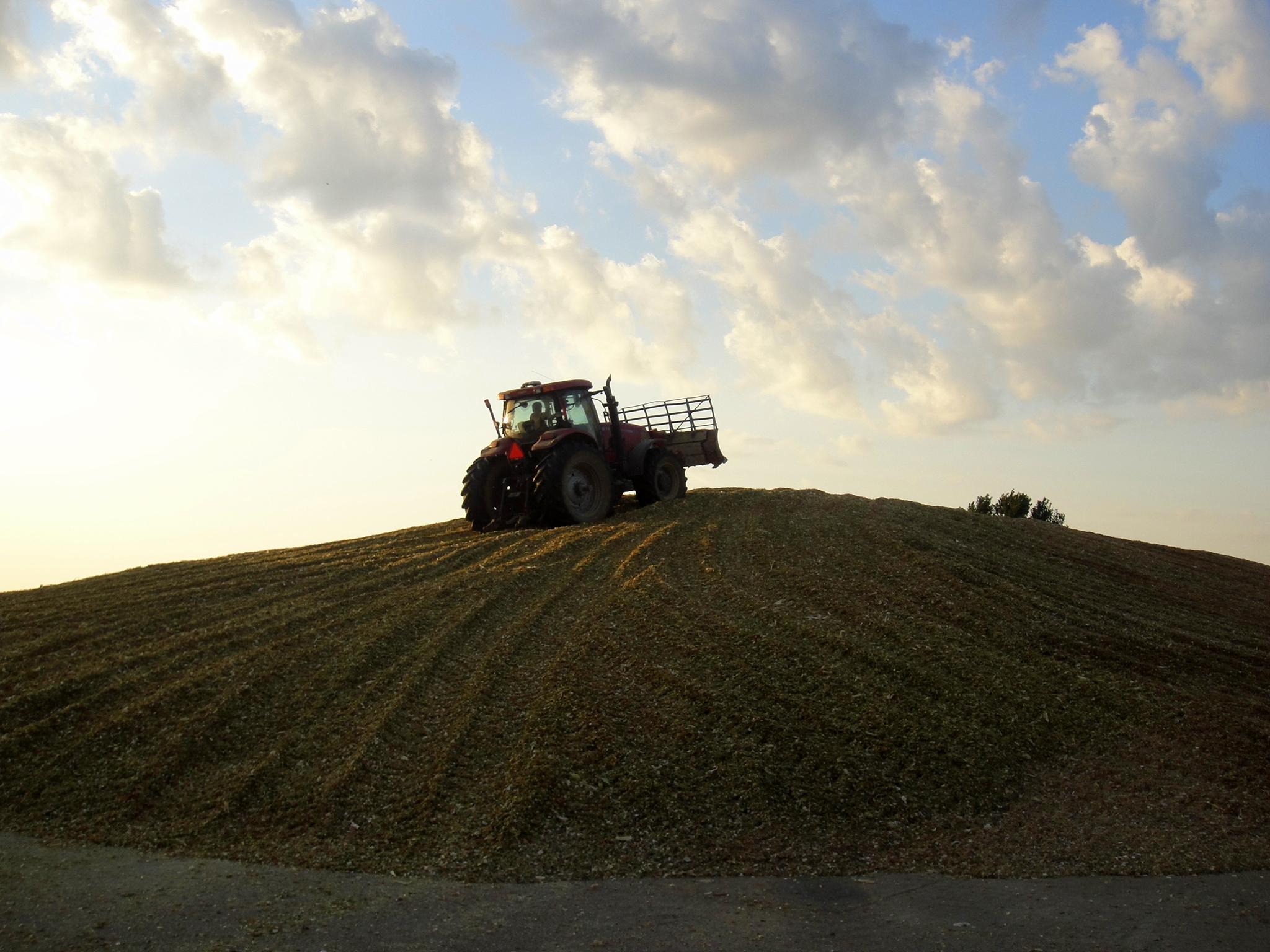
All 700+ acres of our corn is harvested for cow food. Corn is just one of the many ingredients that goes into our feed rations, but it is by far the biggest component. Unlike sweet corn, which is grown for biped consumption, our corn grows all summer long and is harvested right before it dries up.

During corn harvest, a machine called a chopper drives through the field and chops up the corn, stalks and all. This product is called corn silage.
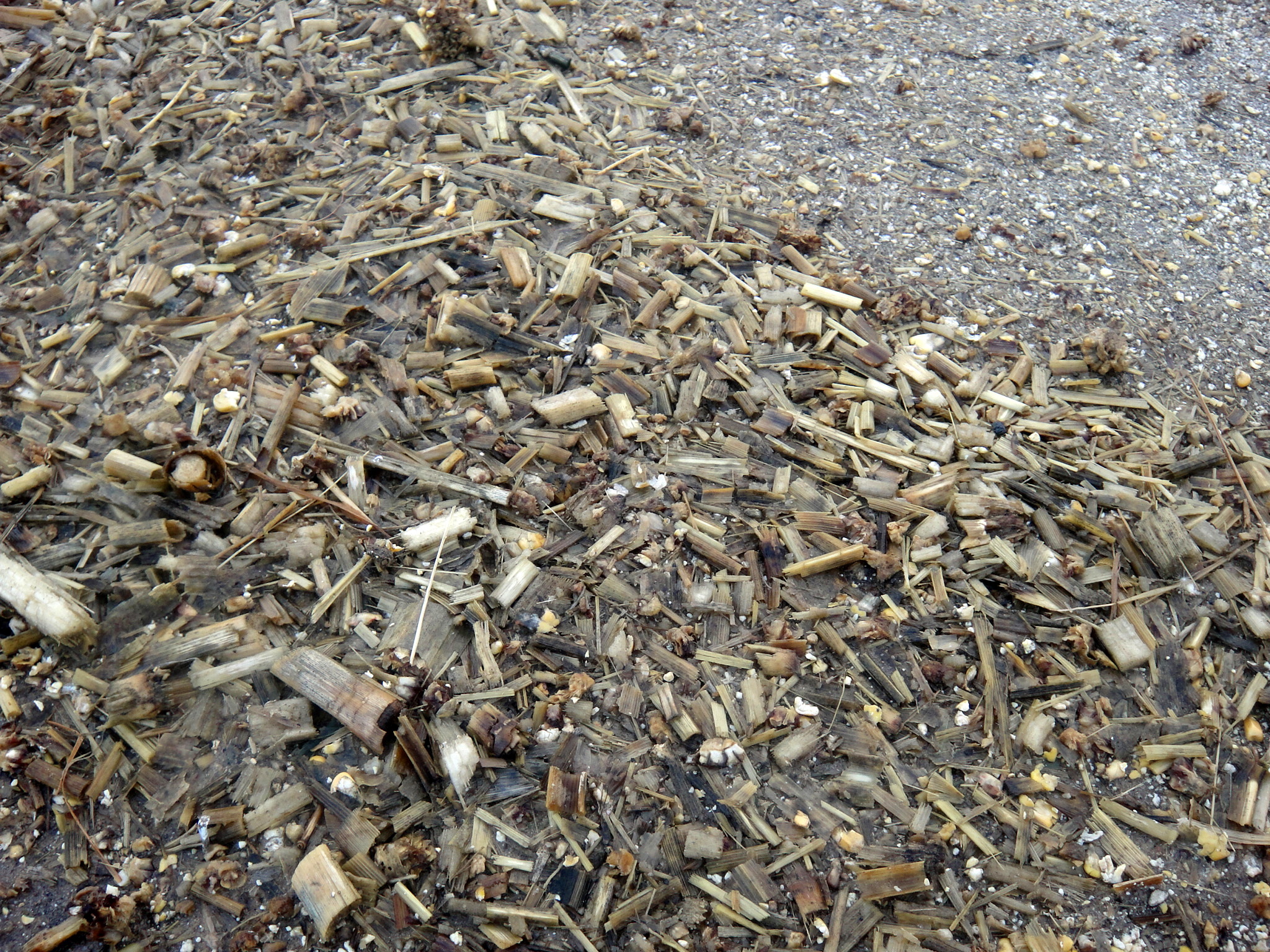
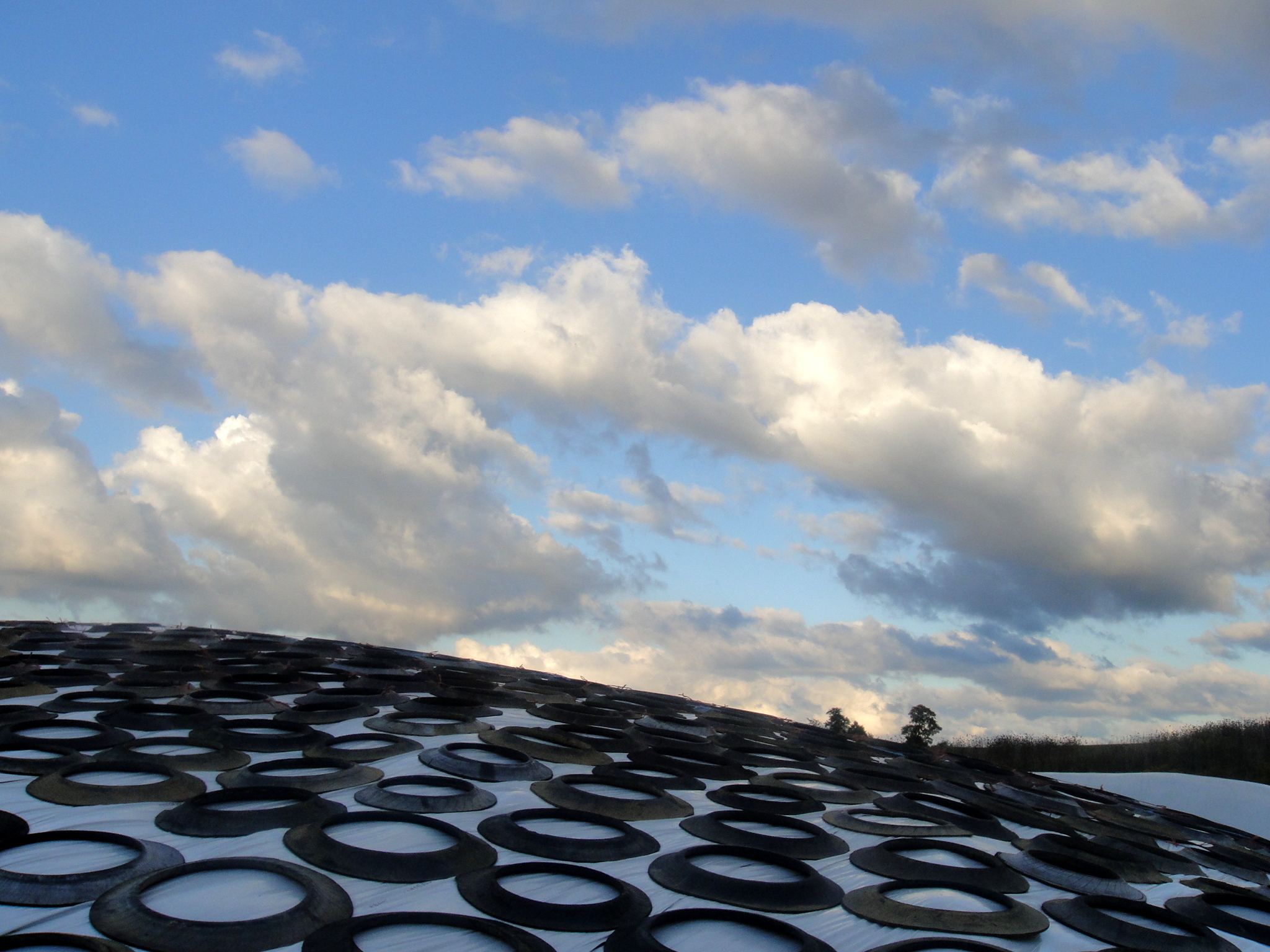
When you harvest corn, you have two options for storage: in ag bags or in large packs covered by plastic sheets and tires. The Dairy Man and his father used both methods of storage this year. Ag bags are easier to seal to ensure that the corn silage doesn’t get moldy, but packs are more space-efficient. Since we had a LOT of corn to put up this year, we went with both.

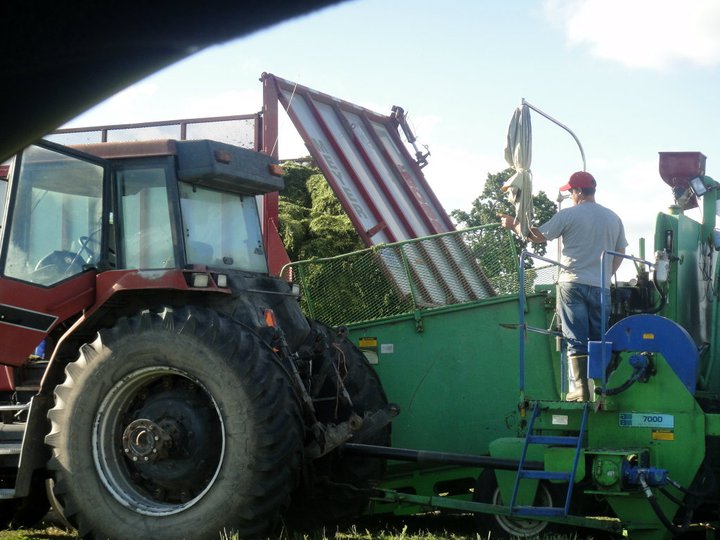
The process of bagging corn silage is essentially identical to that of bagging hay. Trucks drive the silage to the bagger and the Dairy Man makes sure the bags get loaded properly.

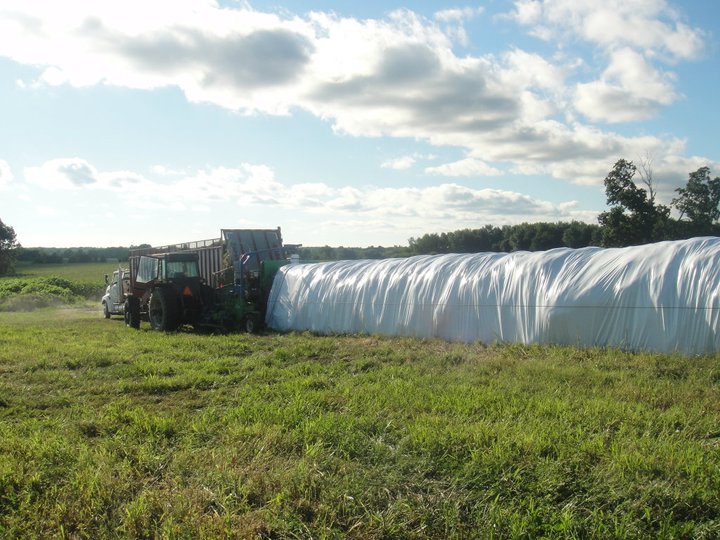
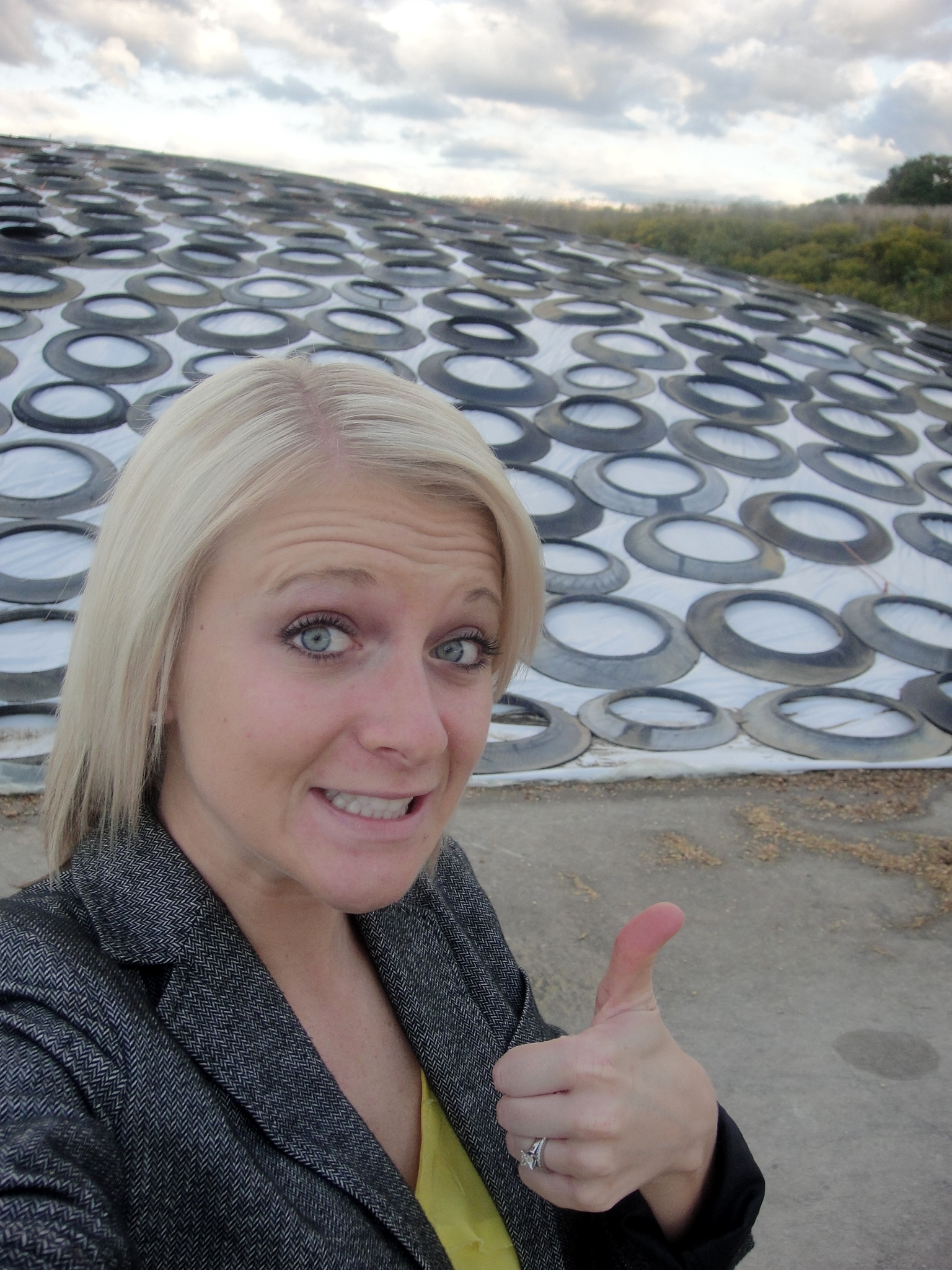
Packing corn silage, on the other hand, involves making a huge pile of corn and driving over it with a tractor to pack it. Hence: the pack. Once the pack is finished, the farmers cover it with plastic sheets and tires to keep out any trace of oxygen.

One night I had the opportunity to ride on the pack with the Dairy Man. And, oh dear, I was bored after about 30 seconds. Basically the Dairy Man drives up and down, up and down, up and down the pack ALL DAY LONG. Backwards, forwards, backwards, forwards, backwards, forwards. Talk about seasickness. The reason they undertake this monotonous task is because the pack of corn has to be tightly compacted in order for the corn silage to be preserved over the next year. So they drive on the pack. Up and down. Backward and forwards. All.day.long. My husband is a better man than I.
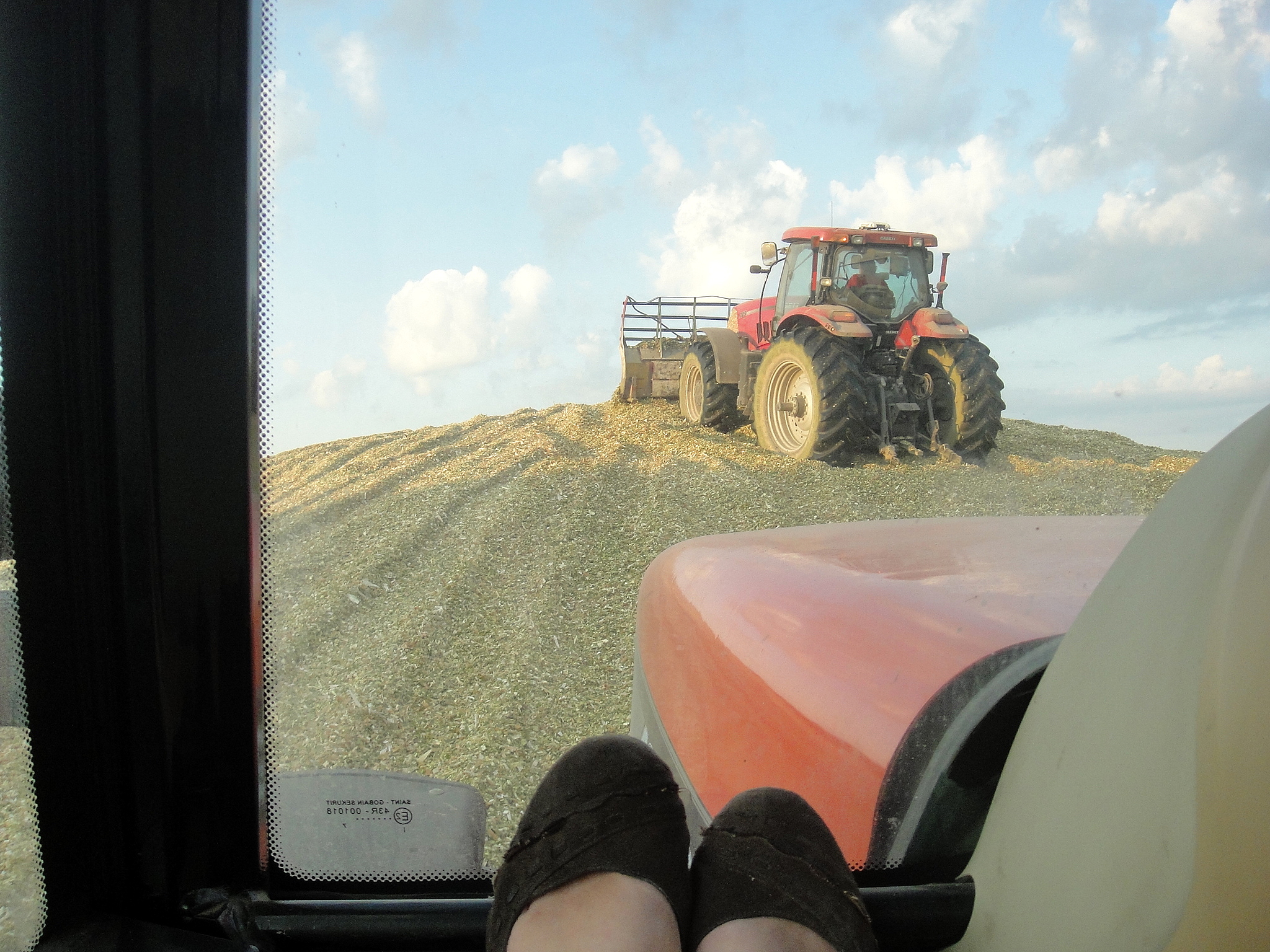
Though, I must say, the view from the top of the pack wasn’t half bad.

Corn harvest is finished, but our cows will be chowing on the silage from these bags and packs for the next year. And really, it’s all about the cows.
“Boy cows.”

A few weekends ago, our old friend Josh came to visit the dairy. Amongst his many other wonderful traits and skills (sorry, ladies, he’s taken), Josh knows how to film and edit video.  As someone who just discovered the panoramic setting on my normal camera, this skill always amazes me. Josh makes informational videos for his adorable nieces. What a guy. And really, all kiddos should know about cows.

Josh made two videos, a “boy cow” version and a “girl cow” version, the former of which you can view below. There’s no such thing as a boy cow (it’s either a steer or a bull), but that’s how Josh introduced them to his little nieces. It’s an easier transition. Anyhoo. The Dairy Man was running late for the tour that day, so I’m the star …er… narrator of the video. My information is almost always correct—not bad for a gal who didn’t know an iota about farming until she met her Dairy Man.

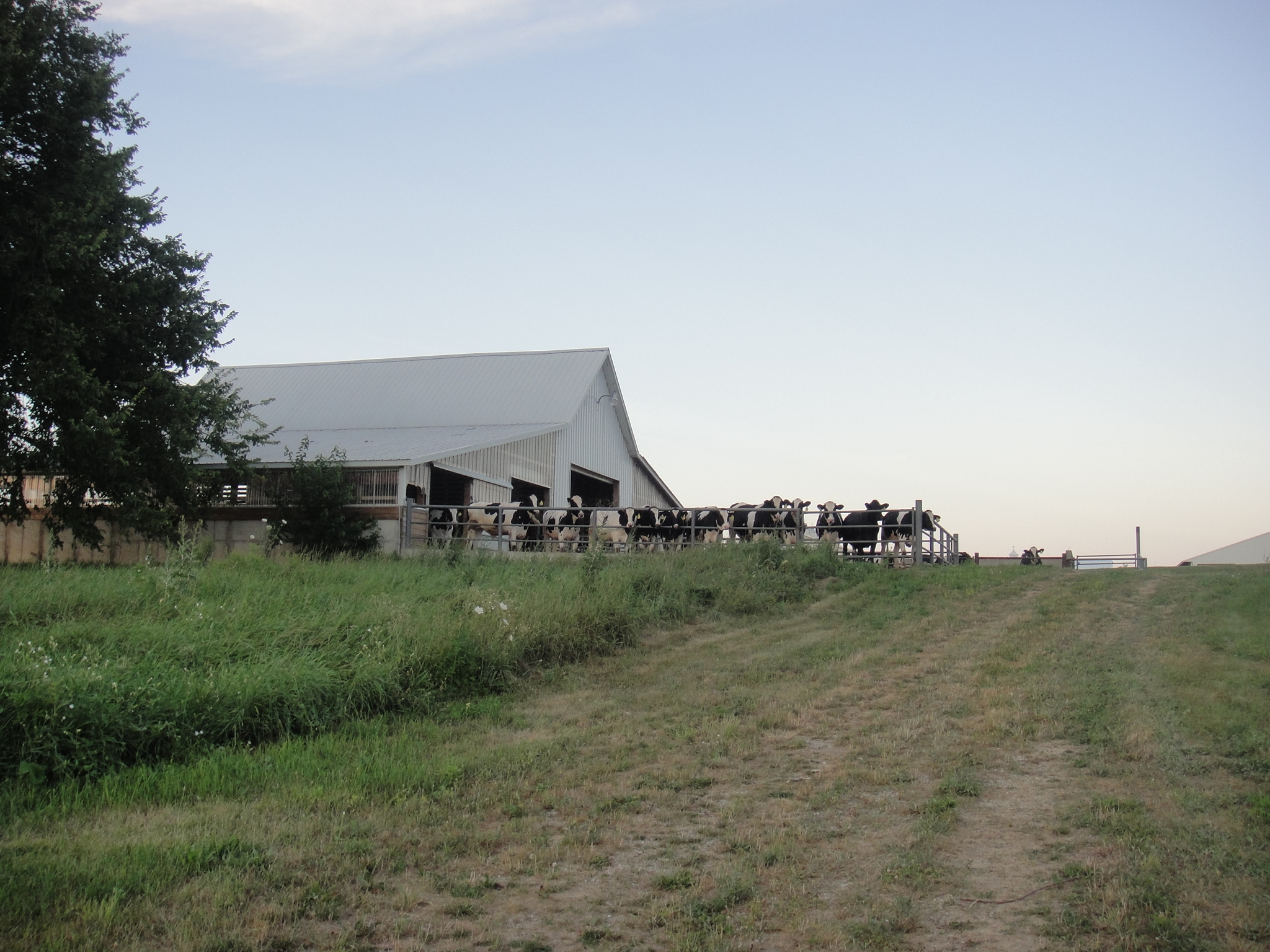
As I explain, steers are male cows raised for beef. They differ from bulls in that they don’t have the parts necessary to perform bull-ish duties. We have a bunch of steers just up the hill from our house; they enjoy leering at us and mooing… all the time.


So, without further ado, enjoy this brief video introducing you to the dapper gentlemen on the dairy: the steers. They are incredibly friendly and love to lick things. And people. And cameras.

(*Disclaimer, after watching this video, the Dairy Man informed me that the steers are more like 15-18 months old. Not two years. Close, but no cigar.)

Moo.

Make hay while the sun shines

This is a post I’ve been meaning to write at three different points this summer. Not coincidentally, that is the exact number of times the Dairy Man and company have cut hay. Now, as we start thinking about our fourth and final hay cutting of the season, it’s finally time to explain this crazy process. Get ready for me to drop some serious ag-knowledge on you.

Three to four times a summer, I lose my husband to the hay monster.

I’m happy to say that hay cutting only lasts a few days (as opposed to a few weeks of corn harvest), but what it lacks in duration, it makes up for in insanity. During hay cutting, the Dairy Man routinely sits in a tractor into the wee hours of the night and never has a break longer than 20 minutes at a time.

Poor, naïve me didn’t know a thing about hay cutting until this year. The Dairy Man and I married late in the summer of 2010 and thus I dodged the bullet for one more year. But I was quickly brought up to speed this year.

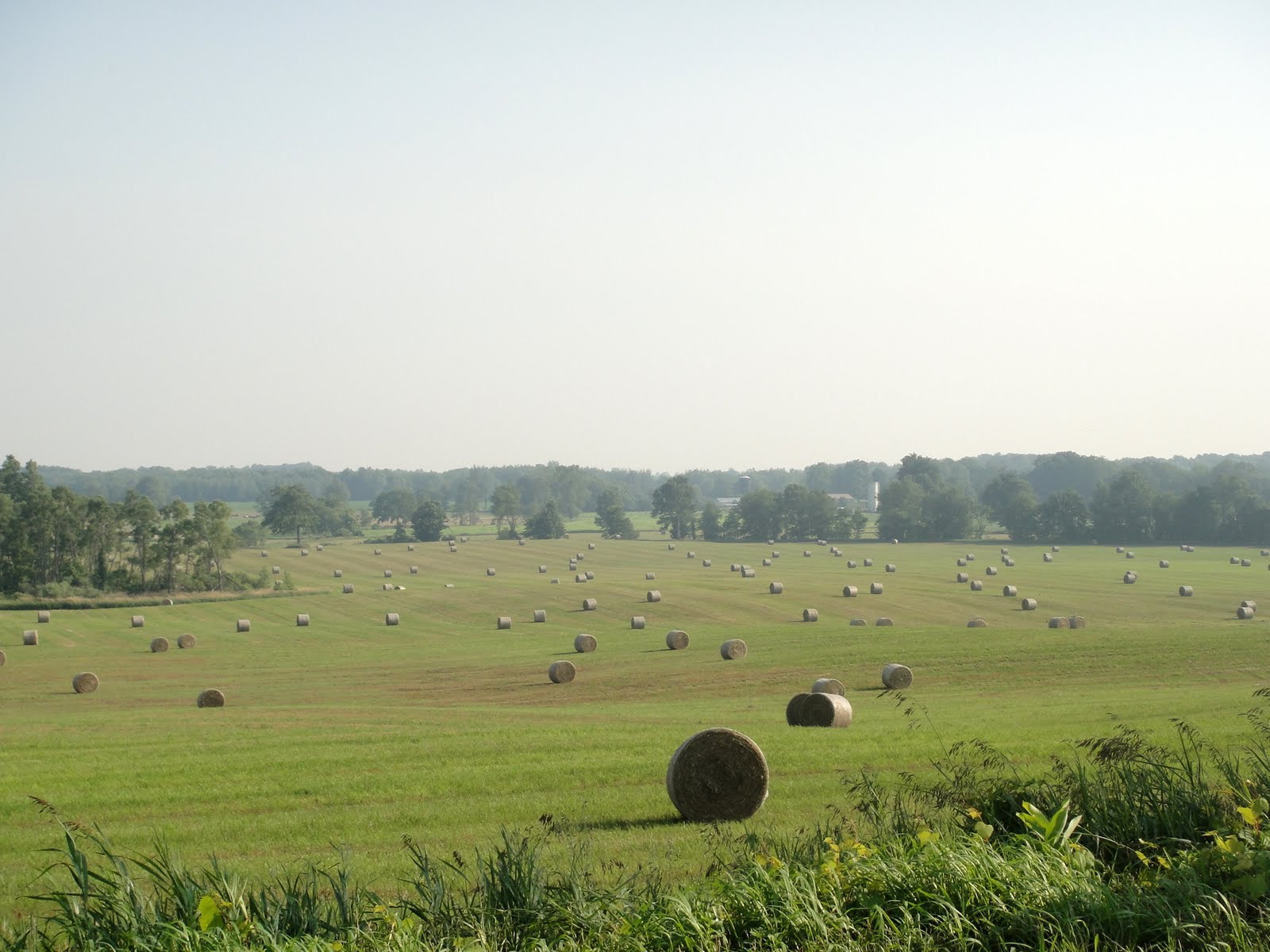
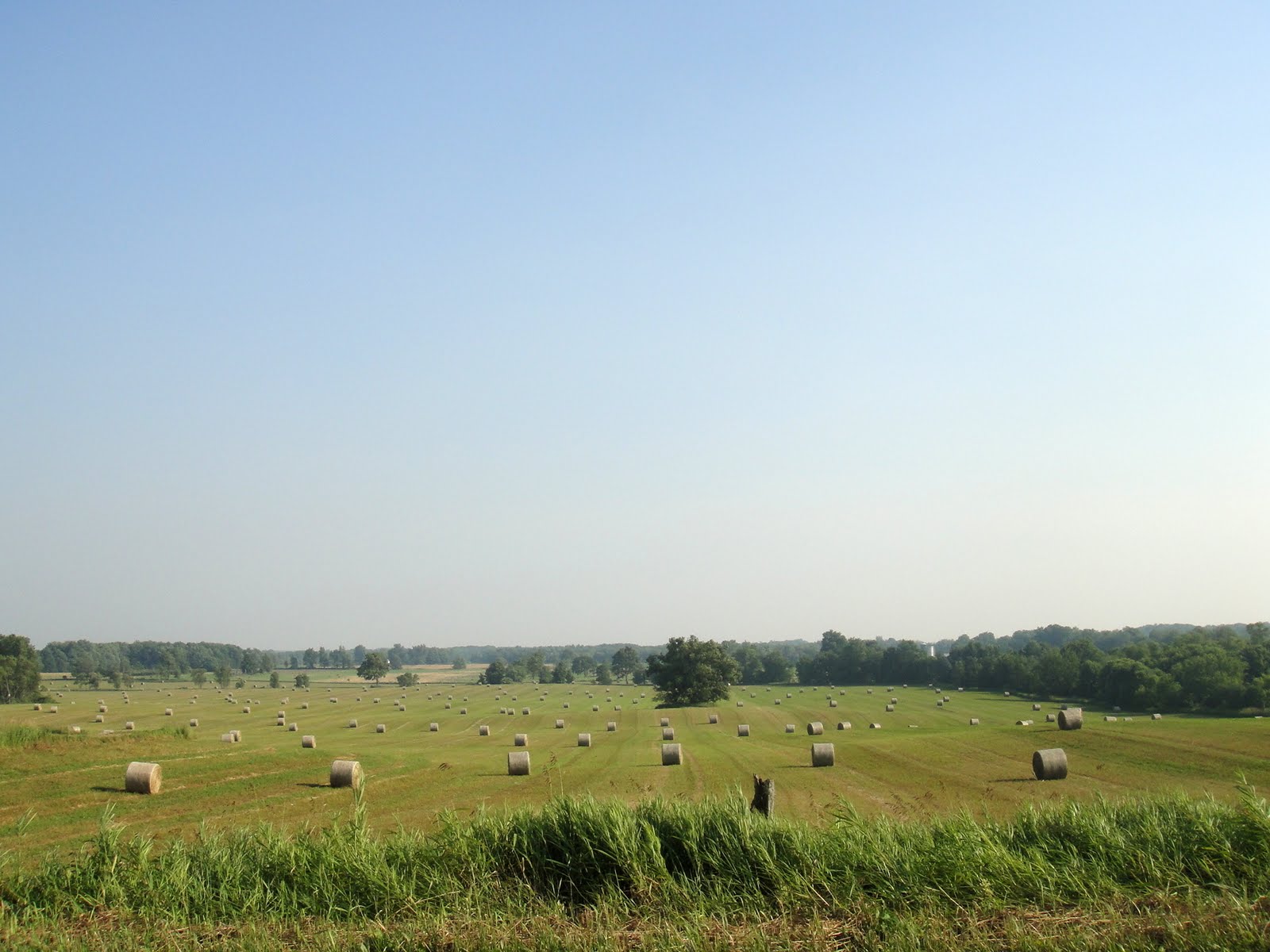
First and foremost, these are hay bales.

Aren’t they lovely? There is something about a nice bale of hay lounging in a kelly green field that just epitomizes the country life. But how did these bales get here? What are they used for? And where do they go?

Hay/grass/alfalfa is used for animal feed. Specifically for our dairy, we add hay silage to our cow feed ration. (Don’t worry if that term doesn’t mean anything to you. Someday I will bore you all silly with a description of a feed ration. Get pumped.) Farmers cut hay 1-4 times each summer—depending on heat and rainfall—or approximately every 30 days.

So, what exactly goes into the process of cutting hay? I thought you’d never ask.

Each farmer is a little different, but our (and I use the word “our” in the loosest sense of the word. I’m a supportive observer. Maybe I should switch my pronoun to “his”?) haying process has five steps.

First, we cut the hay down in the field. Second, we wait for the hay to dry.

Third, the hay is raked or merged using a big machine (this helps to dry it out).

Fourth, the hay is baled or chopped. Fifth, if the hay is chopped, it is loaded into ag bags (pictured below) to be mixed into feed during the winter. Bales are stacked in the barn to be used for immediate feeding.

Jersey the dog really enjoys this part.

The Dairy Man and family both bale and chop hay. Personally, I’m partial to the bales. They’re so pretty. I have  this insatiable desire to try and roll one down the hill.

I was a journalism minor in college, so naturally I had a few questions for the Dairy Man after he explained this process. I won’t always get this detailed in my farming 101 explanations, but perhaps it will be interesting to learn about the iconic hay bales you may see whilst driving through the boondocks.

Why do you have to wait for the hay to dry?
Because hay can spontaneously combust if it is too wet. Yes. Combust. As in light on fire. Burn the barn down. On a less dramatic side, it can also get moldy.

How long will the hay sit in the ag bag before it becomes cow food?
Hay needs to ferment in the bags for a few months before it is usable in feed.

 Why can’t you just cut hay once? Why on earth do we keep cutting it, letting it grow, and cutting it again? This is craziness!
You have to cut the hay before it blossoms. Once the stalks bloom, they start to allocate nutrients towards seeding and reproduction—thus depleting the nutritional value of the hay. Since we want our ladies to eat spinach instead of iceberg lettuce (yes, that’s an analogy; the cows don’t eat salads), we cut the hay when it is full of nutrients.

Why do you have to work like a madman to get the hay in rather than spreading the process out over a number of days?
The farmers are trying to stay ahead of the rain. Once the hay is cut, you don’t want it to get rained on. If the hay is rained on, the nutrients can drain out of the hay and it becomes worthless. That’s why they will work until 2 a.m. or for 16 hours straight.

While there are many intricacies of haying I’m probably leaving out, this is the jist. Even a modern farm wife should have some idea what goes on around the farm, right? I’ll give you a minute to recover from all of this new knowledge.

Now, on to corn harvest. Oh boy.

Shoo, fly, don’t bother me.

There are certain things in this life as a modern farm wife that I’ve simply come to accept. Dirt driveways; phone calls in the middle of the night; two TV channels; dinnertime=moving target; the smell of manure; bellowing moos from up the hill; painfully slow internet; an old farmhouse; living in a town without a Starbucks or a Target; an 80 minute commute to work.

But the things I cannot get used to are the flies.

It’s a fact of life: when you live on a dairy farm in the summer, you share your outdoor space with hundreds of buzzing black flies. There’s something about warm manure pits bubbling in the sun that really gets flies all hot and bothered. Yuck. But the flies do not stay outside. At every opportunity, they sneak into our home to meet their demise at the hand of a flyswatter, lighting fixture, or by drowning in the dog’s bowl.

It seems like every time I open the kitchen slider, at least three flies zoom in. I spend half my life stealthily sneaking up on these pests with a flyswatter in hand. I derive an exorbitant amount of pleasure each time I squash one of the buggers into oblivion. I channel Rambo on a daily basis.

I live amongst the flies. And I do not like it. In fact, it can be downright dangerous. No, really.

This week I was picking up Jersey the dog from the corn field on my way home from work. During corn harvest he gets to hang out in the field with the Dairy Man all day.

I opened my car door to put Jersey in the backseat and cracked the windows to give him a breeze. In so doing, approximately 15 flies made a beeline into my car. I spent the drive home swatting flies away from my face and trying to coax them out the open windows while the pup barked and tried to eat them. By the time I got home, I was convinced we had succeeded.

But I was wrong.

Unbeknownst to me, my car was still buzzing with activity (I crack myself up) when I climbed in the next morning. I was only on the road for a few minutes before they launched an aerial attack: dive-bombing my face, landing on the bare foot pushing the accelerator, and burrowing in my hair. Needless to say, mild panic ensued. My multitasking skills were put to the test as I tried to drive the car, keep my legs in constant motion to prevent flies from landing on them, and open all the windows to create a wind current that would suck out the pests. It was chaos. The car swerved back and forth and I tried to keep it together while squealing “ew, ew, ew!” (in a very dignified fashion).

Eventually the flies exited, but the the emotional trauma remained. Well, not quite trauma. But I was flustered and itchy. Long story short, our dairy will always have flies, but from now on, my windows will always remain up and I will carry a flyswatter in my car.

Bring it on, buggers.

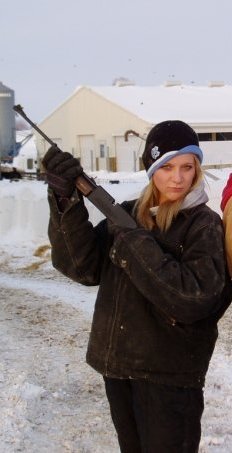
(Enjoy this lovely and threatening picture of me from 2008. Somehow, it just seemed appropriate.)

1 down, 80 to go.

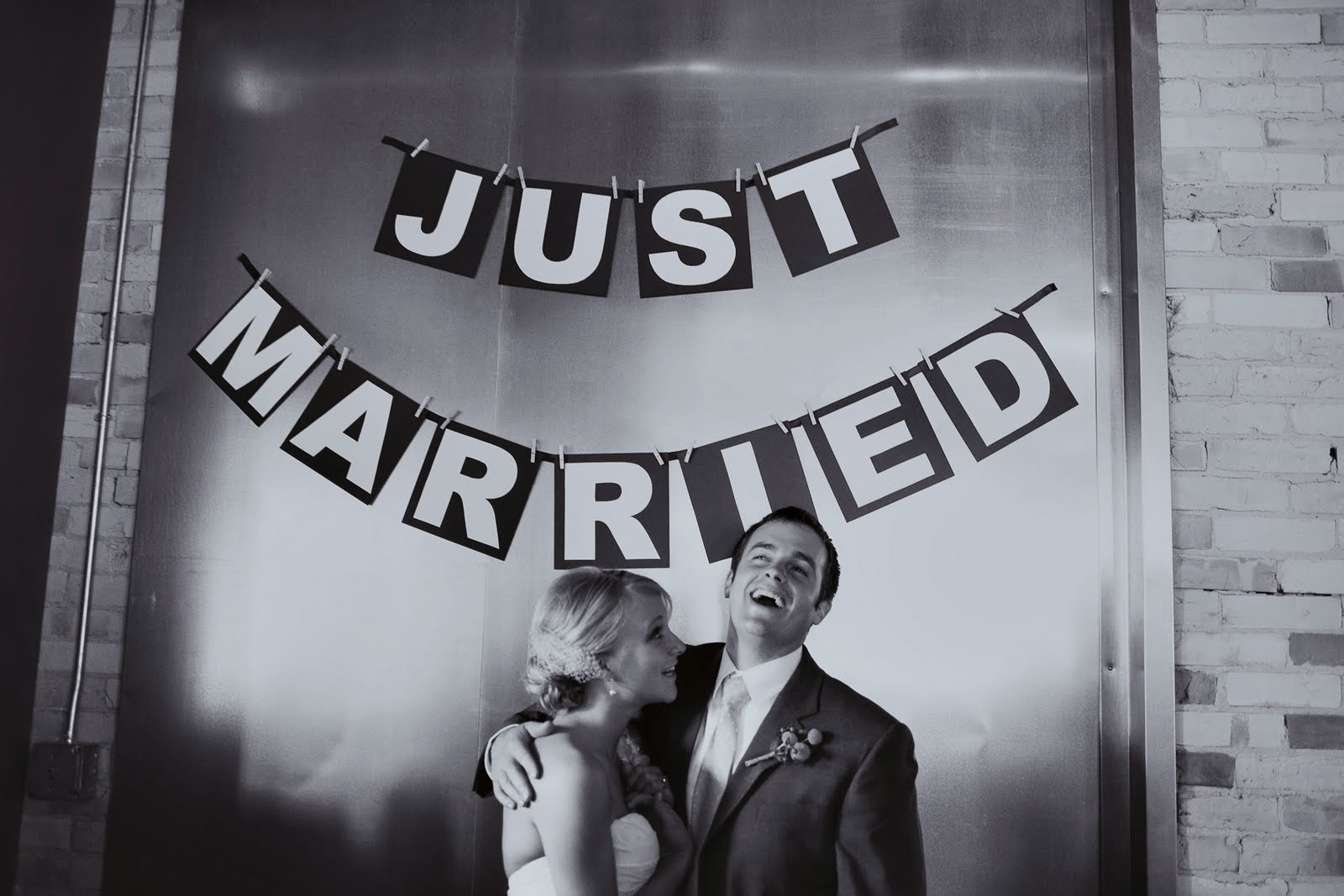
This weekend, the Dairy Man and I celebrated our one year wedding anniversary. As old(er) people say, “My, how time flies!”

It’s hard to believe I’ve been living this country life for an entire year. I can’t really consider myself a newbie anymore. Though, honestly, that ship already sailed the day I started explaining the difference between a heifer, cow, steer, and bull to my boss.

The past year feels like a great accomplishment. It was challenging and frustrating, but it was also filled with unspeakable joy and love. I am more in love with the Dairy Man today than I was on our wedding day. Now that we’ve gotten a chance to get our hands dirty in this thing called marriage, we are even more certain in this life we’re building together.

Unlike many newlyweds, I don’t think that the Dairy Man and I entered marriage with our eyes glazed over with love and rainbows. We’ve always been fairly realistic people. We didn’t enter into marriage lightly or with unreasonable expectations. And I think that’s what has sustained us through this crazy year.

Over the past 365 days, we lived in two different houses in two different locations. We went through harvest season, planting season, and a whole lot of hay cutting. We began the (never-ending) process of renovating our farmhouse. We started a new dairy. We completely gutted and renovated our milking parlor. We lost two beloved grandparents. We got a dog. We joined a church and made new friends.  We lived through power outages, blizzards, 3 a.m. phone calls, passionate disagreements, runaway cows, and one very expensive trip to IKEA.

This year has been tumultuous and unstable. But it has also been rewarding and reassuring. Somehow our farmer/urbanite love has blossomed into a beautiful marriage.

I still remember something my mom said to me a few months after my wedding. The Dairy Man was in the midst of starting the new dairy. I barely saw him and felt marginalized, alone, and unimportant. I was sick of coming second to the dairy. While the Dairy Man was working 15 hour days, I was saddled with keeping everything else together. I resented it all. I hadn’t signed up to do everything myself. But when I lamented this to my mom, she said,

Jess, in a marriage you can’t be so concerned about things being perfectly 50/50. You both have to give 100 percent–all of the time. Things aren’t always going to be equal. You might have to take turns carrying the other. But you should both always try to give 100 percent. That’s what love is.”

My mother is very smart and her advice stuck with me. An egalitarian marriage (as I hoped for) is a great idea, but real life isn’t always that neat and tidy. You can’t just give 50 percent and stop giving. Sometimes we have to pick up each other’s slack. If you go into marriage thinking that things will always be fair and perfectly equal, you’re in for a rude awakening. Especially if you marry a farmer. We will spend our lives trying to find balance.

My happiness required that I accept this. I had to learn flexibility, patience, and grace. I had to be ok with giving more than 50 percent some of the time. On the flip side, the Dairy Man had to shake off years of putting the farm first and learn what it was like to be married.  He had to learn how to prioritize, say no, and invest in life outside of the farm. We’re getting there.

To my husband, thank you for the past year. Today, like that day a year ago, you are it. You are everything. You’ve turned my life upside down and it’s the best thing that has ever happened to me. I may live in the boondocks and have a home that smells faintly of cow manure, but I still feel like myself. Stilettos and all.

Bring on the next 80 years.

Losing my Shadow.

Yesterday was a sad day.

In some ways, I’m more of a country girl than ever before. It’s as though I’ve passed through some terrible rite of passage. But in other ways, I’m still just a tender-hearted city gal mourning the loss of my cat.

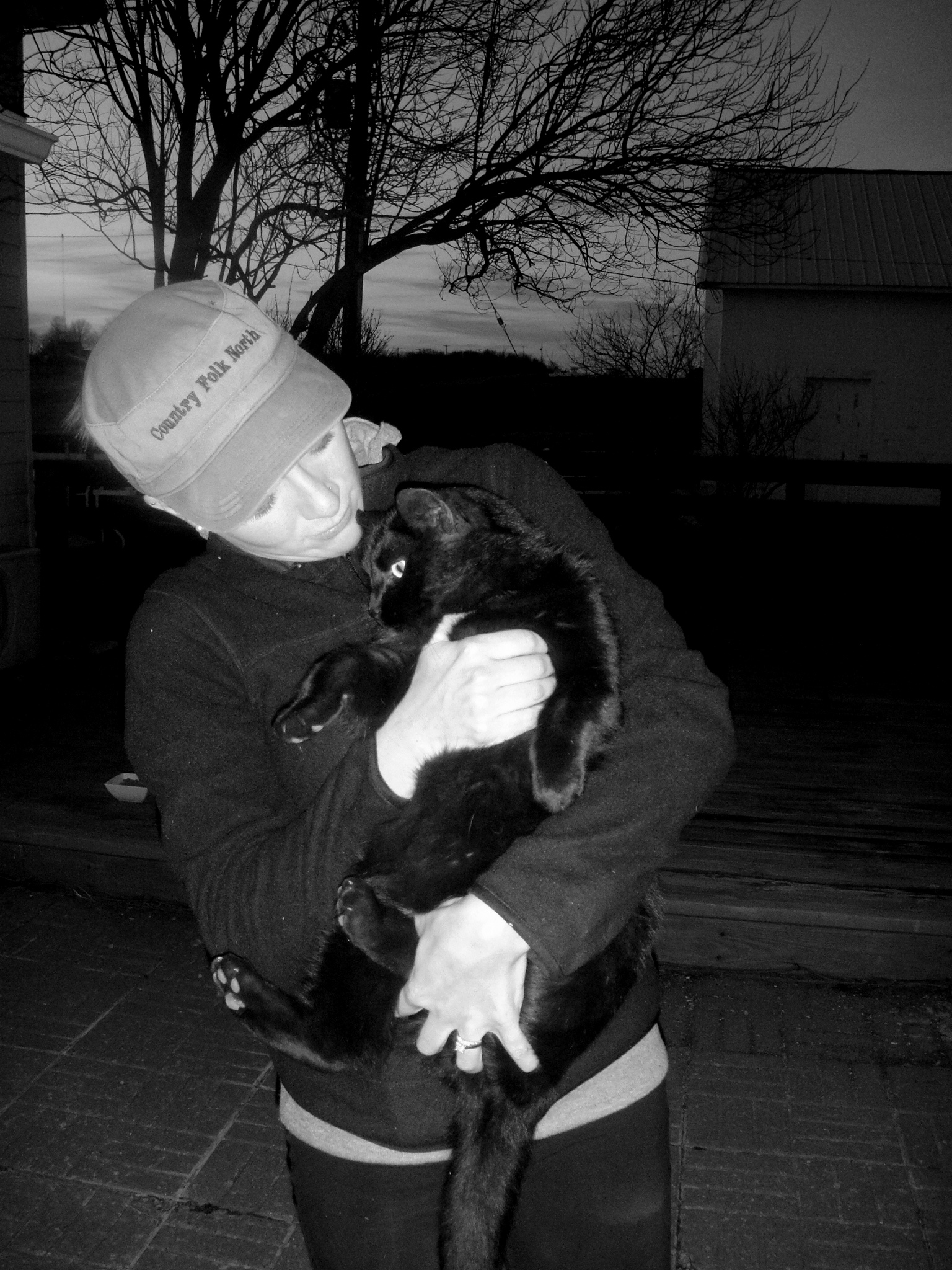
Early yesterday morning, feisty, loving, and fiercely loyal Shadow the cat was hit and killed by a car. This might not seem like a big deal to a lot of people, but it was a big deal to me. He was the first pet I’ve ever had. Unlike most rural folks, I didn’t lose two dogs this way during my childhood. I’ve never raised a piglet to adulthood and dropped it off at the slaughterhouse. I’ve never started up my car in the winter while a barn cat was sleeping in the engine. I’ve never had a pet, so I’ve never had a pet die. Heck, I cried when I ran over a bunny a few months ago. In a lot of ways, I’m still a sissy. And I’m ok with that.

Most people have this experience when they’re five; I’m having it at twenty-five. I feel like that intensifies the sadness. It’s been building up for a quarter of a century. But then I also feel like I’m too old to feel this way. Not sure I care.

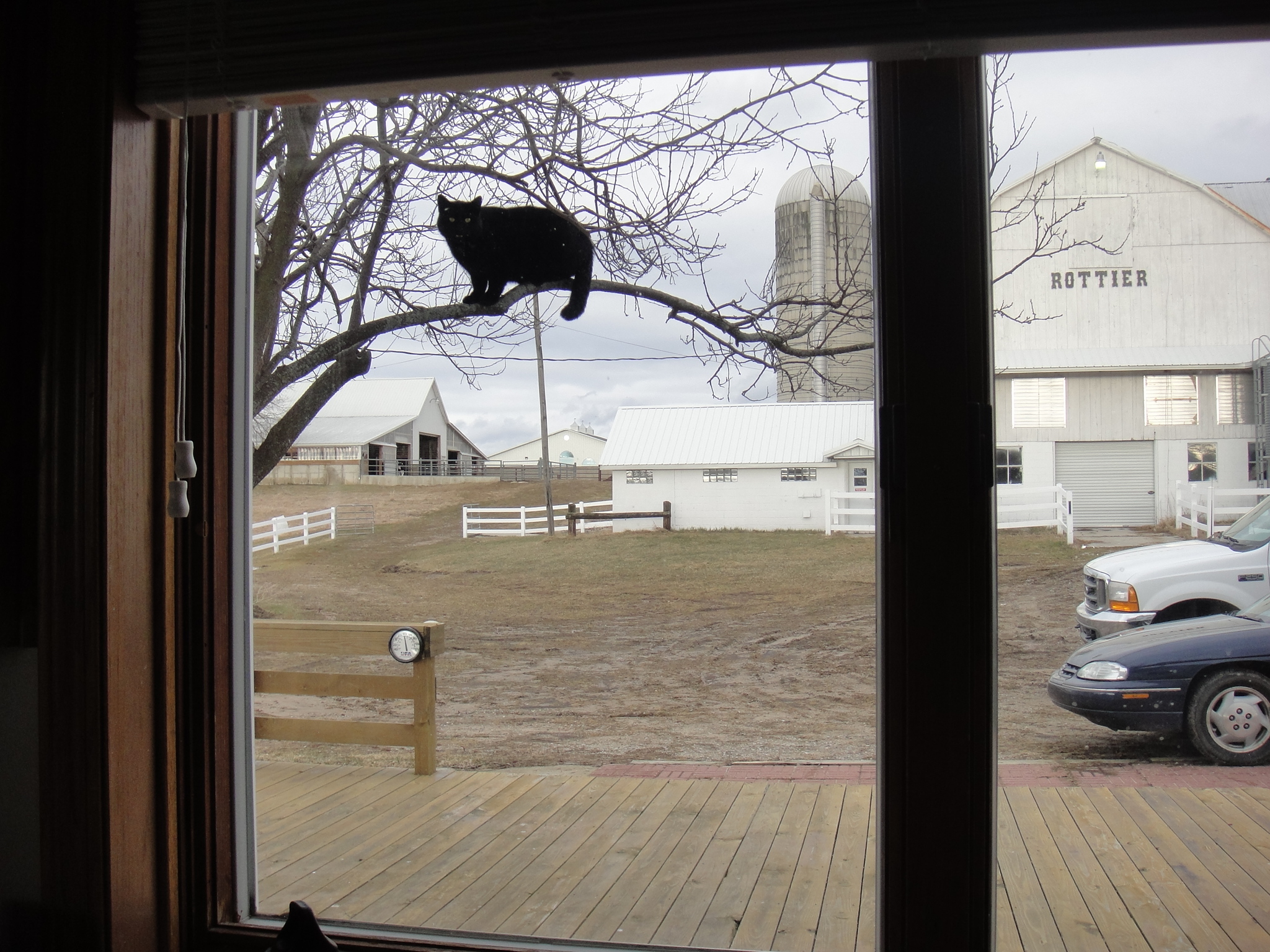
I will miss seeing that ball of black fur racing towards me when I pull into the driveway. I will miss his presence during our dinners on the deck. I will miss watching him chase Jersey the dog around the yard. I will miss his stalkerish leering through the kitchen window.

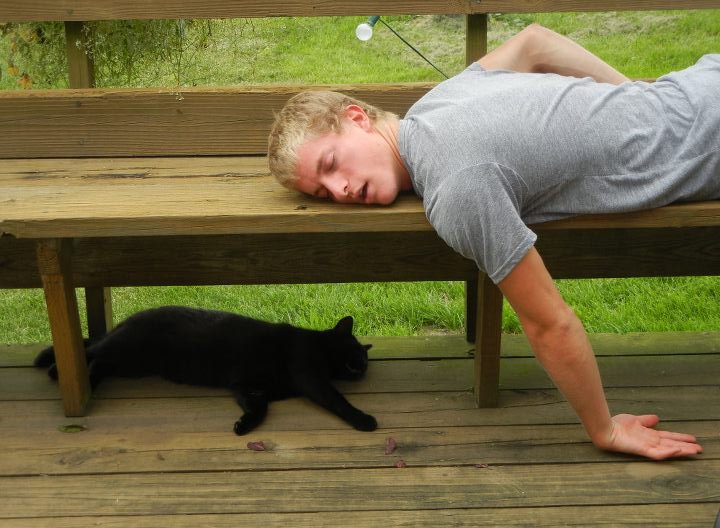
A friend reminded me that Shadow was always a voyeur. He came and went as he pleased, stopping by our house long enough to eat some breakfast and take a nap on the deck. He freely roamed the farm and despite the dairy man’s many attempts, never enjoyed being held. But he was still a member of our hodgepodge country family (yes, I do include the cows) and he will be missed. Even my brother loved him.  You can see the family resemblance.

I promise I’m not a crazy cat lady. I don’t like cats. I just liked MY cat. Shadow weaseled his way into my heart (see this post) when I was feeling alone in a new home and a new town. For that, I thank him.

For now, I will coerce the Dairy Man to give Shadow a proper funeral/burial (no matter how silly he thinks it is) and imagine my cat with wings and a halo, terrorizing all the puppies in pet heaven.

Here’s to you, Cat.

Happy cows come from… Michigan

Perhaps you’ve seen the ads of blissfully happy bovine frolicking through grassy fields in California. Perhaps those cows are happy, but I would like to argue that our Michigander cows are just as content.

Usually a cow spends most of her time in a barn. It’s shaded, cool in the summer, warm in the winter, and she can take naps in the sand. Perhaps a cow cavorting through a pasture (as depicted in certain advertisements) seems like a more idyllic life, but my limited experience tells me that cows prefer to live in a barn and visit the pasture.

Until recently, our dry cows (a.k.a. the pregnant ladies) lived exclusively in a barn. They had sawdust to lie in, a feed bunk to snack at, and spent the days chatting with their buddies. But the Dairy Man wanted to give them more options.

Many years ago, our dairy was a buffalo farm. We’ve changed a lot of things to make it more suitable for dairy cows, but one thing we haven’t been fully utilizing are the pastures. The Dairy Man hemmed and hawed over what to do with these grassy expanses. Buy goats? Rent them out for track and field competitions? Nay. It was time to let the cows play.

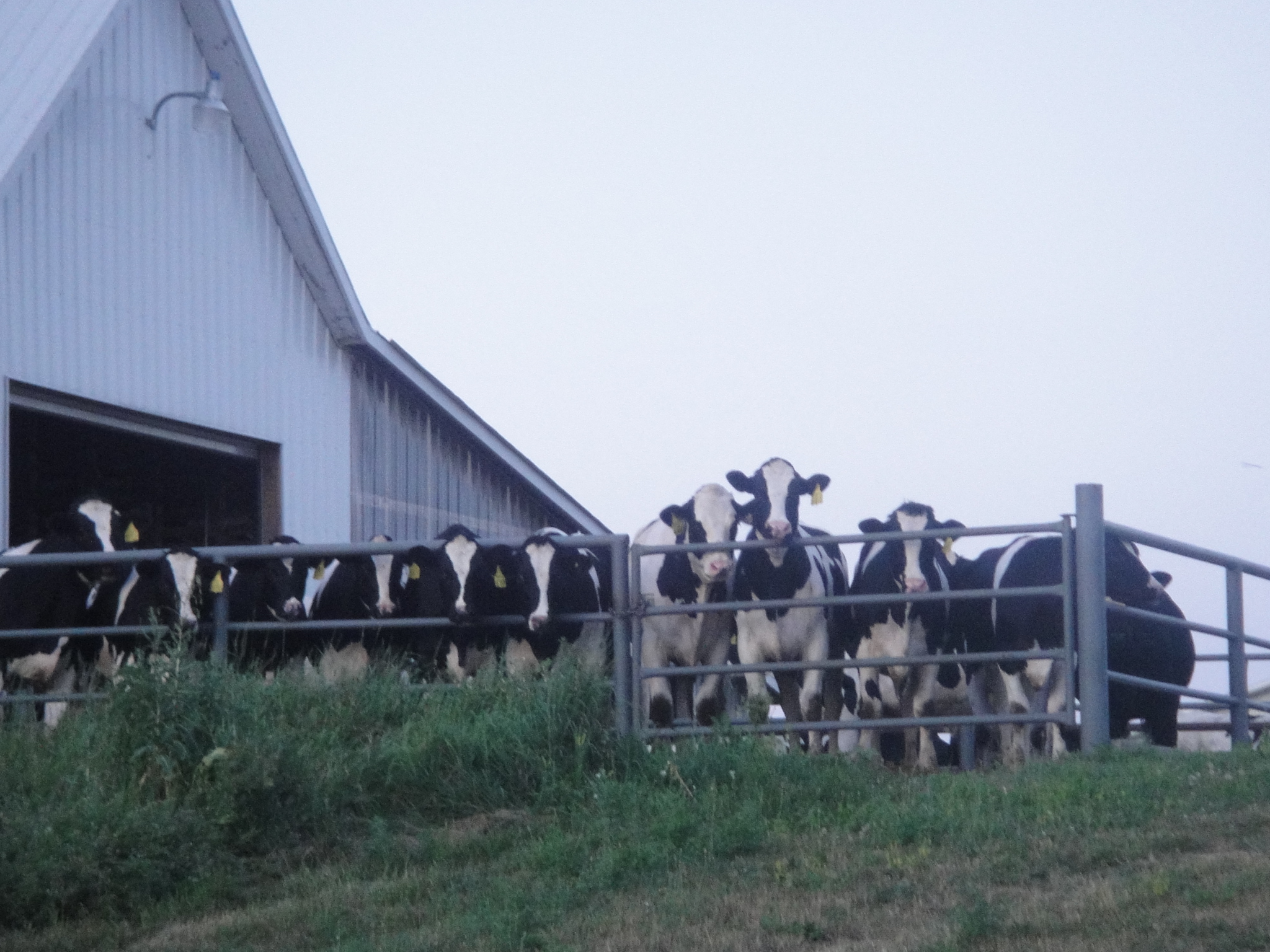
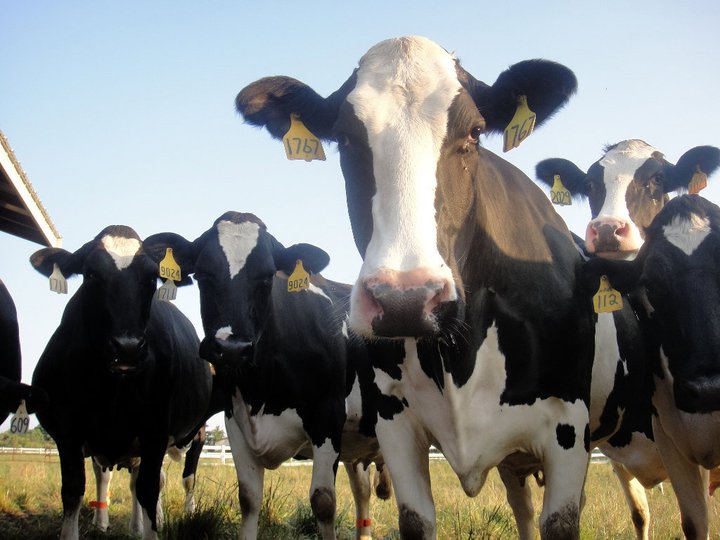
Now our dry cows can decide if they want to be in the barn or graze in the pasture. It’s not unusual for me to look out the dining room window and see 100+ cows hanging out across the driveway. Based on my observations, they enjoy mooing at cars, competing in foot races, and eating, eating, eating.

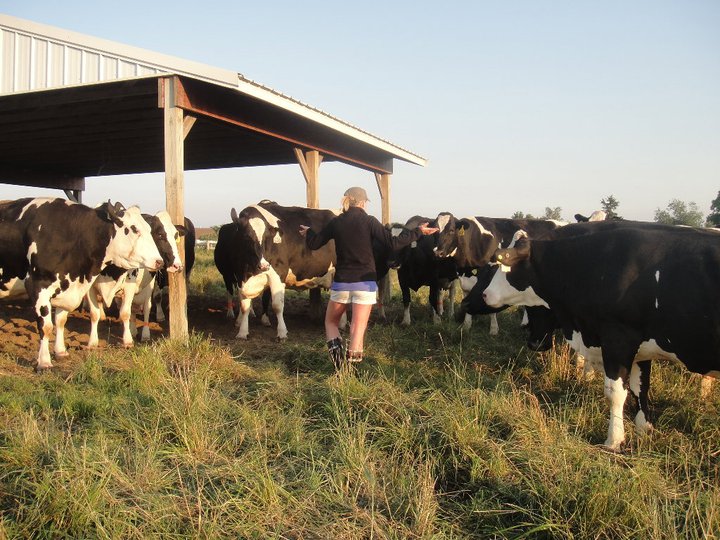
One evening the Dairy Man took me into the pasture to get up close and personal with the preggos. Usually cows shy away from strangers—as proven by my many fruitless attempts to pet them—but these girls were startlingly friendly.

Maybe it was the hormones.

As someone who is adjusting to my first dog, getting up close and personal with animals is still a new phenomenon for me. Sometimes I can’t believe that I share my homestead with 300+ cows, 3 cats, countless pigeons, and 1 dog. I feel like Laura Ingles Wilder. Or Snow White.

Let’s just say that white shorts were a poor choice for our evening jaunt to the pasture.

Yes, that cow is licking my posterior. They are sneaky buggers.

I tried to explain the type of friendship where friends don’t have to lick one another other, but I don’t think I got through to them. It was, however, a lovely pow-wow (cow-wow?).

When all was said and done, I felt brave, accomplished, and more like a dairy wife than ever. Going into the pasture was, without a doubt, the closest I have ever been to cows. And I didn’t hate it.

Cows aren’t so bad, as long as you’re wearing boots.

A family of three.

I am the best wife ever. No, really.

A battle has been gently raging in our home for several months now. In one corner: a Dairy Man who wants a dog. In the other: a modern farm wife who doesn’t.

Until recently, the battle was at a complete standstill. In a marriage, if one person wants a dog but the other doesn’t, you really can’t get a dog.  You can’t just come home with a puppy one day and say, “Don’t worry, honey. He won’t affect your life at all.” It’s like having a kid. Both parents need to be on board.

And I was SO not on board.

Don’t get me wrong, I like dogs. I like petting other people’s dogs. I like playing fetch with other people’s dogs. I like taking other people’s dogs for walks. But I especially like sending the dog home with those other people.

Maybe it’s because I’ve never had a pet in my entire life, other than Jewel the 15-cent fish who only lived for 36 hours and a certain barn cat named Shadow. I’ve certainly never taken care of anything large or furry that might pee on the kitchen floor. I don’t have the foggiest idea how to care for a “real” pet. And yes, I’m the girl living on a 300+ cow dairy.

For a while, the Dairy Man and agreed to disagree. But after a while, his arguments started to get more convincing than mine.

MFW: I ‘m gone from the house for at least 12 hours every day! I don’t have the time to care for a dog or give it attention.
DM: We live on a farm! I can take him with me to work and check on him all day. He won’t ever be cooped up for too long.

MFW: I love my shoes and I don’t love cleaning urine off the carpet.
DM: The dog could live outside or in one of the barns! He/she wouldn’t ever have to come in the house.

MFW: It will be like having a baby.
DM: I don’t want a baby. I do want a dog. Besides you can’t teach a baby to herd cows.

The more the Dairy Man stepped up to take responsibility, the more my resolve weakened. So I made a decision. The Dairy Man’s birthday was in a few short days and I had the perfect gift. A little research found me a breeder. And a few deep, cleansing breaths later, I was ready. That’s how we ended up weaving through country roads on a Friday night looking for Baird Farm Kennels. The Dairy Man had no idea where I was taking him, but he was beyond excited when I told him, “You get to pick out your puppy!”

One million wife points earned instantly.

The Dairy Man made a connection and thirty minutes later we were on the way back north with a puppy in tow.

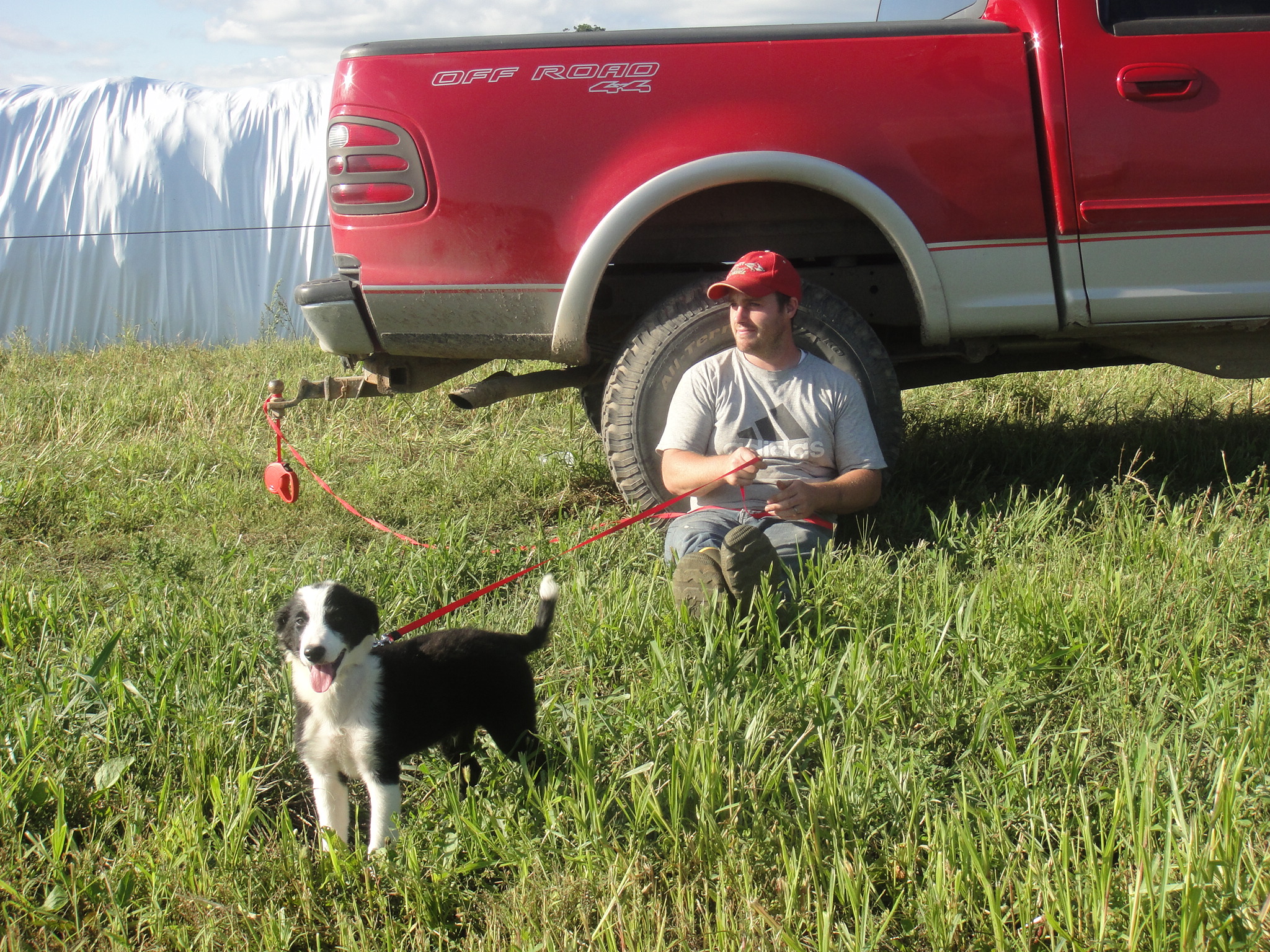
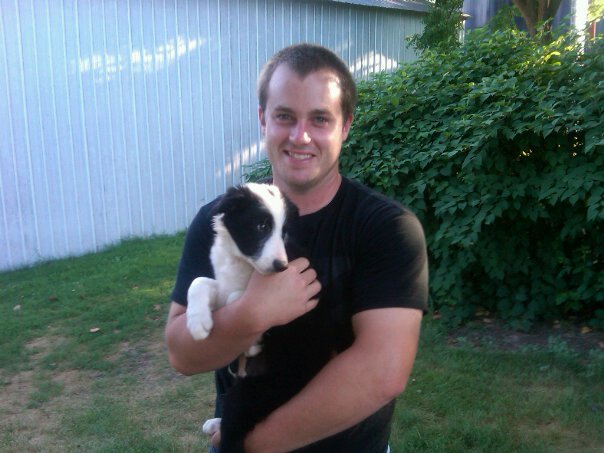
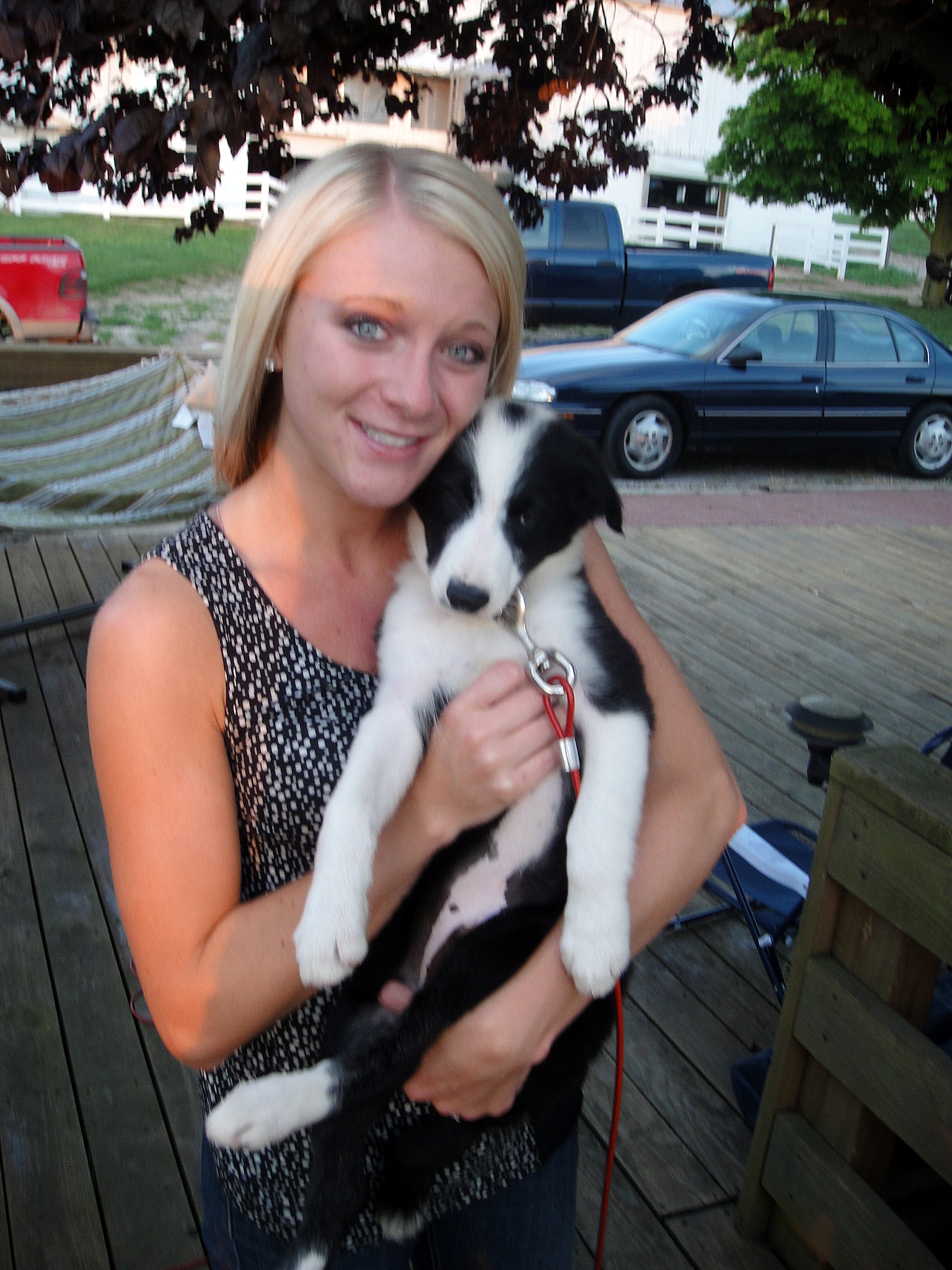
This is Jersey. He is a 10 week old Border Collie puppy with a sweet disposition and the cutest little crooked tail.

We tossed around a lot of names, but somehow “Jersey” stuck. Jersey like the cow, of course. (For all of you dairyites: yes, “Holstein” would have been more accurate name due to his coloring, but Jersey is a much cuter name. And we’re all about being cute.)

For now, Jersey will sleep in the kitchen. When he’s a little bigger we will turn him into a rough and tumble outdoor-lovin’, cow-wranglin’ canine. The Dairy Man will take him to work, slowly introduce him to cows (he is terrified of them at the moment), and become best friends.

Not to toot my own horn, but this may have been one of the Dairy Man’s best birthdays. And since the actual day is today, allow me to give a shout out to the DM:

Happy birthday, babe! Thank you for your encouragement, your strength, and your love. I love you and I love our new family. And I’m even starting to love the cows.
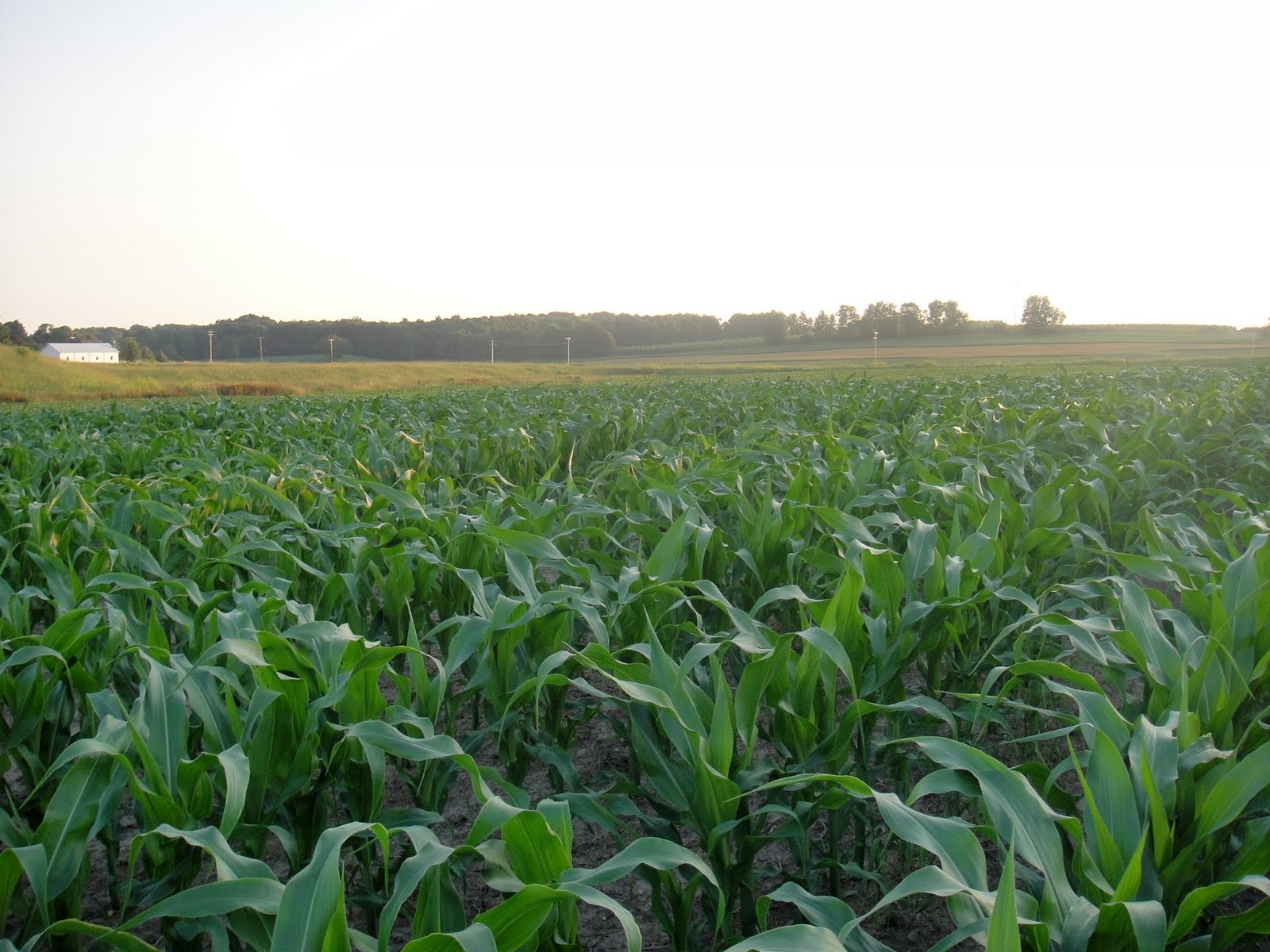
(Ps: check out the steers in the background of this picture!)

Knee high to a grasshopper

What a silly unit of measurement.

I often picture a weathered old farmer using this adage while wagging his finger at me: “Well, when I was knee high to a grasshopper, we had to walk uphill to school both ways in blinding snowstorms.”

The longer I’m around farmers and farming, the more I realize that many of our great adages can be tied back to farming. For example:

Don’t count your chickens before they’re hatched
Don’t look a gift horse in the mouth
Don’t cast your pearls before swine
Make hay while the sun shines
Don’t let the foxes guard the henhouse
You can lead a horse to water, but you can’t make him drink
Trying to find a needle in a haystack

And of course, my personal favorite: let’s party till the cows come home.

Seriously. Farmers must be the smartest people in the world to be responsible for all of that wisdom! At least that’s what the Dairy Man tells me.

A few weeks ago, I added another adage to my holster.

This spring was less than ideal for planting corn. It rained and rained and rained. The fields were wet and muddy. But despite a rain-soaked spring, my Dairy Man managed to get his corn seed into the ground before it was too late. Corn harvest will take place sometime in September, but until then, we have a handy little saying to tell us if the yellow stuff is doing ok.

I give you: knee high by the fourth of July.

Sure, this post is just a teensy bit past the fourth of July, but this saying is worth talking about. A few weeks ago it was flying around the farming community with reckless abandon. If your corn is “knee high by the fourth of July,” all is well and you’ll be able to harvest on time.

Naturally, my knees and I had to see things for ourselves.

So the Dairy Man and I took an evening stroll to check on our corn.
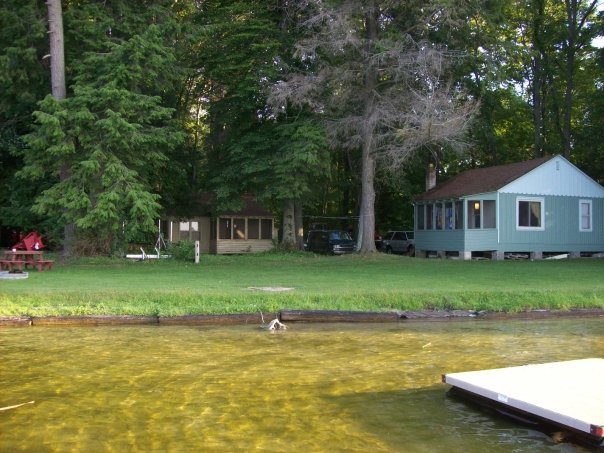
From my vantage point, things were looking good. Leafy. Green. You know, Cornish.

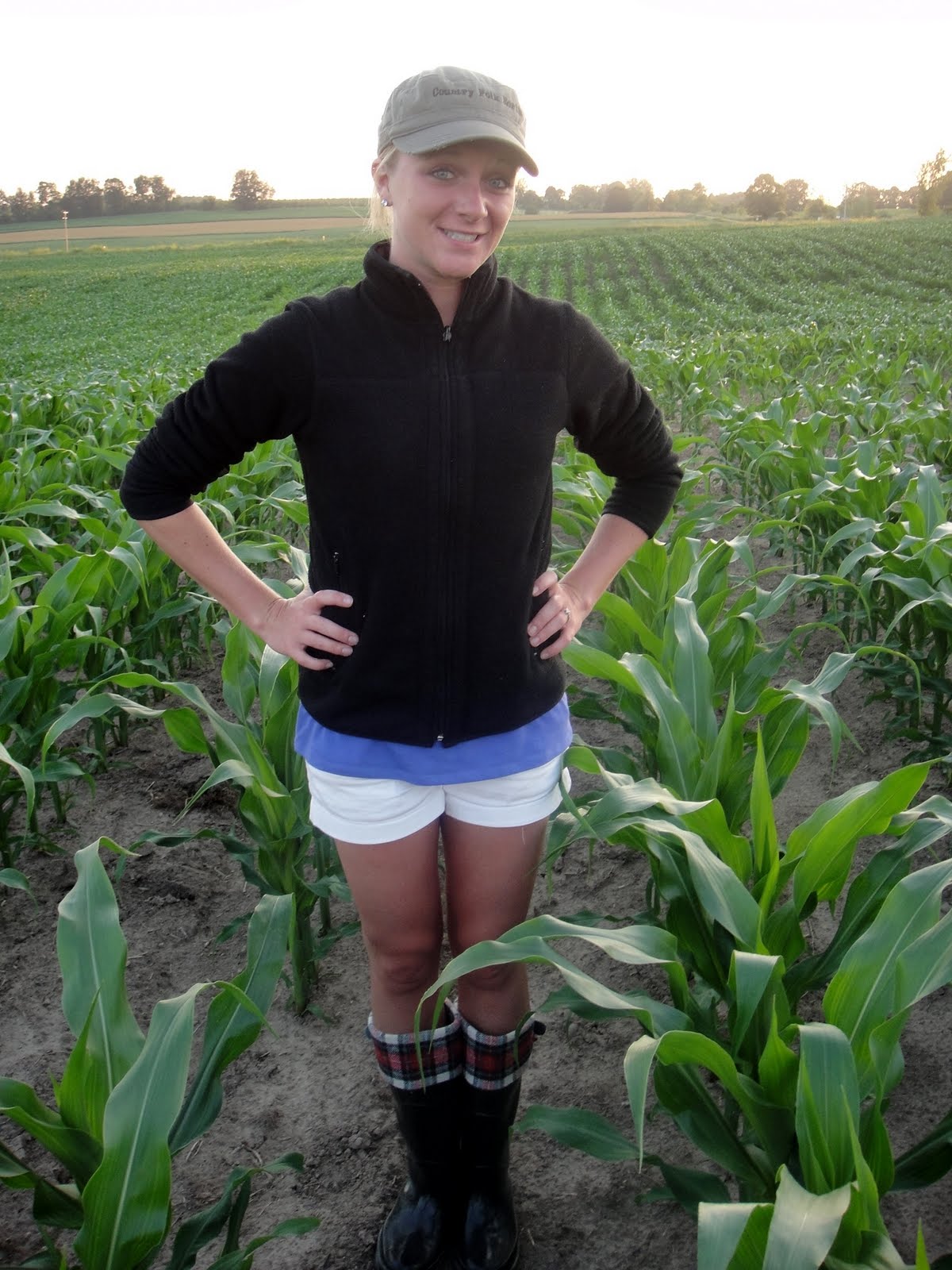
But then it was time for the test. Was our corn tall enough? I should mention that, at 5’4’’, I’m probably not the ideal person to be testing your corn. My knees are just a little low to the ground. Nonetheless, I surveyed the situation.

The verdict? We are right on track. Though, the green stuff actually surpassed the needed knee high. You could say it was “thigh high by the fourth of July.” It’s got a nice ring to it, though I’d rather talk about my knees.

Research completed, the Dairy Man and I started our trek home back through the fields. The fireflies were just starting to appear as the sun slowly sank into the horizon (or, in our case, into the orchard across the street). Beautiful, quiet moments like this make the craziness of farming seem just a little more bearable.

Plus, the corn is doing great.